The 1996 50 cent coin value is not really about the date alone. Most pieces are ordinary. The gap starts when the coin is cleaner, sharper, better preserved, or struck in a different format. That is where the price begins to move.
What Coin the Market Is Pricing
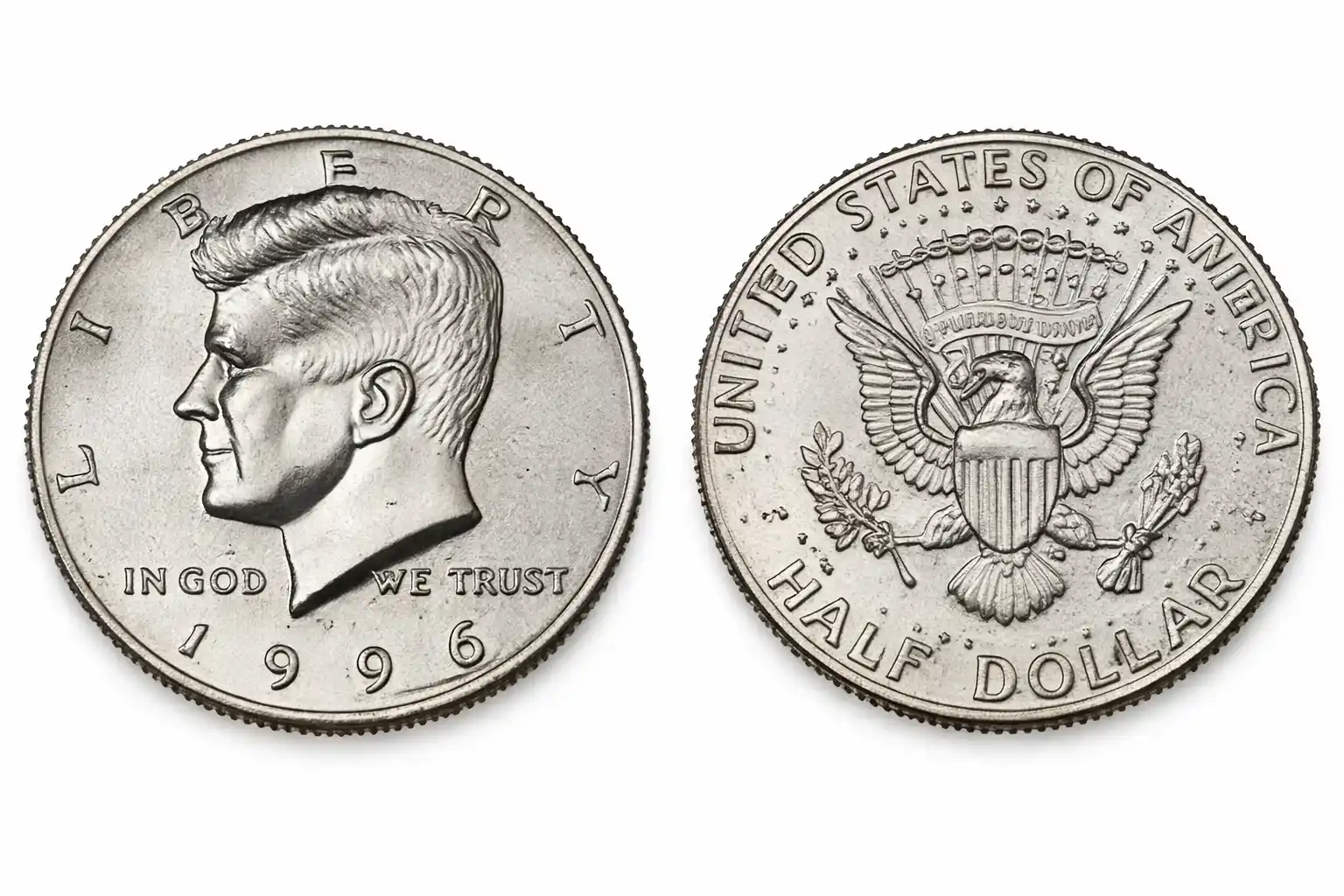
A 1996 half dollar is not one coin in one form. There are four main pieces that matter in the market: 1996-P, 1996-D, 1996-S clad proof, and 1996-S silver proof. Philadelphia struck 24,442,000 coins. Denver struck 24,744,000. The San Francisco Mint made 1,750,244 clad proofs and 775,021 silver proofs. That already tells you where the first price split begins.
Version
Broad Range
1996-P business strike
$0.50 – $50.00
1996-D business strike
$0.50 – $310.00
1996 proof issues
$2.15 – $40.01
1996-S silver proof melt floor*
$24.48
*Silver melt changes with the market. This figure was listed by Greysheet and NGC in March 2026.
That table is only a quick frame. It does not mean every coin fits neatly into those numbers. It shows the real point: common business strikes stay cheap for a long time, while better grades and silver proof pieces move into a different lane.
The First Small Detail Is the Version
Most people start with the year. The market starts with the format. A worn 1996-P is still just a common circulation strike. A nice 1996-D can be more interesting in the top Mint State grades. A 1996-S clad proof is a proof coin with mirror fields, but it still has a clad composition. A 1996-S silver proof has a built-in metal floor because it is 90% silver.
That is why two coins with the same date can sit far apart in the market. One is traded like modern pocket-change material with a small premium. The other is traded as a proof issue or as a silver-backed collector coin. The date matches. The pricing logic does not.
Grade Moves the Price Faster Than the Date
This is the main point of the article. For 1996 Kennedy halves, grade matters more than the date itself. The 1996-P is fairly common through MS66, scarce in MS67, and very scarce in MS68. Greysheet makes the same point in broader terms for modern Kennedy business strikes, noting that pieces above MS66 or MS67 are conditional rarities rather than ordinary coins.
That is where many readers misread the coin. They think “1996 is modern, so it must be cheap.” That is true for most pieces. It stops being true when the coin has a real shot at the upper registry grades. PCGS auction records show how sharp that jump can become: the 1996-P has reached $432 in PCGS MS68, and the 1996-D has reached $1,292.50 in PCGS MS68. Those are not prices for average coins. They are prices for the condition rarity.
The practical reading is simple:
Circulated pieces usually stay near face value
Lower Mint State pieces usually stay modest
MS67 starts to matter
MS68 is a very different market
Surface Quality Changes the Result
Once you get past the date and mint mark, the next price divider is the surface. For business strikes, heavy marks on Kennedy’s cheek, dull luster, rough fields, and small rim hits can hold a coin down even if the piece is technically uncirculated.
A cleaner coin with stronger eye appeal can land in the better part of the same grade band and sell faster. This is one reason why the jump from ordinary Mint State to premium Mint State is not only about the label. It is also about how the coin looks in the hand.
For proof coins, the standard changes. The market looks for clean mirrors, strong contrast, and minimal hairlines. Haze can hurt. So can light friction from poor storage. A proof coin can still be real and still be worth less than the owner expects if the surfaces are cloudy or marked.
Proof Coins Need a Different Eye
The 1996-S clad proof and the 1996-S silver proof are not judged like circulation strikes. Their main strengths are mirror fields, frosted devices, and clean presentation. The silver proof also carries different metals, different weights, and a different price floor. In other words, this is not only a grade question. It is an issue-type question.
This is one place where a coin checker can be useful without turning the article into a gadget pitch. Unlabeled flips, weak photos, and mixed proof lots can blur the line between the clad and silver versions. A tool that shows composition, weight, and issue type can help keep the right coin in the right bucket before you judge the price.
There is also a supply point here. The U.S. Mint reported 2,175,535 Proof Sets sold for 1996 and 748,712 Silver Proof Sets sold. That helps explain why clad proofs are widely available while silver proofs stay in a smaller pool. A smaller pool does not always mean rare. It does mean the market starts from a different base.
Silver Content Changes the Floor
The 1996-S silver proof has one advantage the other 1996 half dollars do not have: melt value. Its silver content is 0.3617 ounce with a melt value of around $26.28 on March 25, 2026. The exact number moves with silver. The larger point stays the same. A silver proof does not fall back toward face value the way a common clad coin does.
That does not make every silver proof expensive. PCGS describes the 1996-S silver proof as well struck and fairly common in PR68 to PR69 Deep Cameo. The premium gets stronger only when the coin is cleaner, sharper, or pushed into the perfect PR70 tier. PCGS lists a $1,150 auction record for a PR70 example, which shows how sharply the market can separate a top coin from an ordinary one.
What Helps and What Does Not
Some details lift the price. Others only create false hope.
May add value
Better grade
Cleaner surfaces
Stronger luster
Deep cameo proof contrast
Silver composition
Certified top-grade status
Real mint error
Does not add value
Scratches
Cleaning
Fingerprints
Dull haze
Rim damage
Spotted storage damage
Random wear is called an “error”
That last line matters. Real mint errors can add value. Post-mint damage usually does the opposite. On a modern Kennedy half, that distinction is important because the base coin is often common enough that damage leaves little room for recovery.
Should You Grade One
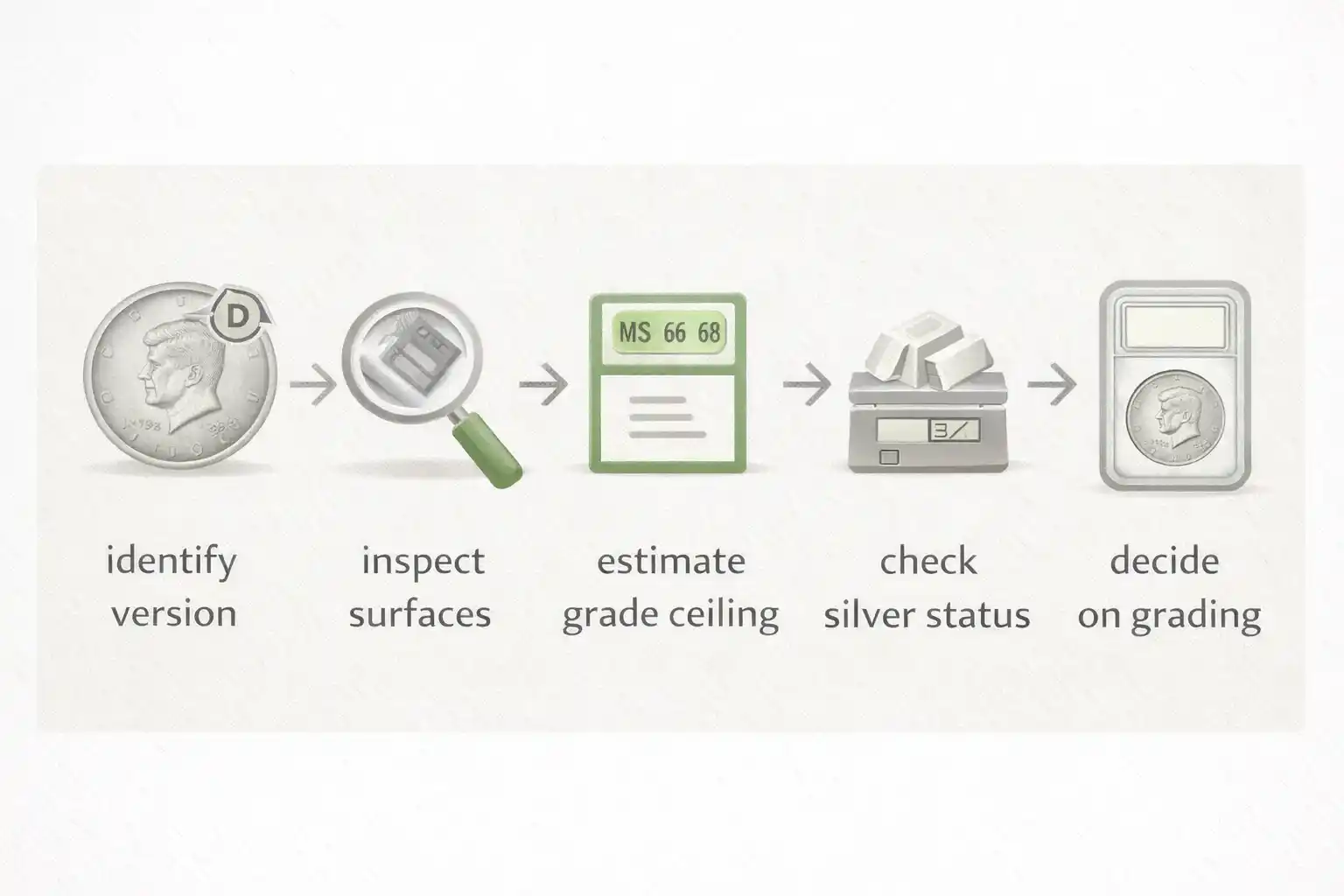
Most 1996 half dollars do not need certification. The better candidates are strong business strikes that may reach the upper Mint State levels, clean proofs with a real shot at top proof grades, silver proofs with premium surfaces, and legitimate mint errors. Commonly circulated examples usually do not justify the cost. How to know these basics? Refer to the free coin value app.
Coin ID Scanner helps you keep the four 1996 versions sorted, compare basic specs, and avoid sending the wrong coin down the wrong path. That is useful before grading fees enter the picture. After that, the real decision still comes down to surface quality, grade ceiling, and market demand.
Final Take
The 1996 half dollar is a good example of how small details change the price. The year is only the label. The real value drivers are the version, the grade, the surfaces, the proof quality, and the silver content in the 1996-S silver proof. Most pieces are common. Some are better than they look. The market pays for the difference.